A Famous Name That Changes the First Impression
Pompey’s Pillar in Alexandria seems to promise a straightforward story. Its name suggests a monument to Pompey the Great, the Roman general who fought Julius Caesar and later fled to Egypt. A visitor might reasonably expect the column to honour his life, mark his death or identify a place connected with his remains. None of those explanations fits the evidence. The monument belongs to a much later period of Roman rule, more than three centuries after Pompey died. A Roman prefect named Publius dedicated the column and the colossal statue above it to Emperor Diocletian near the end of the third century AD.
That correction answers the immediate question, but it also opens a better one. How did a monument to Diocletian become Alexandria’s supposed memorial to Pompey? The answer involves a missing statue, a damaged Greek inscription, generations of travellers and the remains of a temple complex that once gave the column a very different setting. Understanding those layers changes the visit. Travellers can begin to see the pillar not as an isolated object with an inaccurate label, but as part of Alexandria’s long history of Egyptian tradition, Greek culture and Roman power.
What Visitors Actually See at the Site
The column dominates the site because most of the buildings that once surrounded it have disappeared. Its surviving structure rises to nearly 27 metres, including the base, shaft and capital. Craftsmen cut the main shaft from a single piece of pink granite quarried near ancient Syene, modern Aswan, and Roman engineers transported the immense stone north. The shaft alone measures more than 20 metres and weighs an estimated 285 tonnes. A grey granite capital crowns it in a Roman interpretation of the Corinthian order. Stone from southern Egypt, Roman monumental design and an Alexandrian religious setting therefore meet in one structure.
Modern photographs often make the pillar appear complete, yet ancient viewers saw something taller and more direct in its message. A colossal porphyry statue of Diocletian, probably around seven metres high, originally stood above the capital. Eighteenth-century observers recorded large fragments of that armoured figure near the monument, although the pieces later disappeared. With the statue in place, the full composition may have reached about 34 metres.
The empty capital explains why the pillar’s purpose now feels uncertain and why later visitors could attach a different story to it. Without the figure of Diocletian, the column no longer identifies the person it once honoured. Nearby sphinxes and surviving foundations offer another important clue.

They show that the structure never stood alone as a roadside memorial or grave marker. It occupied a prominent position within the Serapeum, one of ancient Alexandria’s most important sacred complexes.
Diocletian and the Message Above Alexandria
Diocletian ruled an empire under intense pressure. Civil conflict, rival claimants and regional revolts had weakened Roman authority throughout the third century, so he reorganised imperial government and presented firm central rule as the answer to instability. Egypt mattered greatly to Rome because its agricultural production helped supply the empire. When rebellion challenged Roman control, Diocletian campaigned in Egypt and captured Alexandria in AD 298 after a difficult siege. Roman officials then needed to restore order and make imperial authority visible.
Publius, the prefect of Egypt, dedicated the monument to Diocletian during the years that followed. The Greek inscription gives the emperor a title often understood as guardian or protector of the city. Ancient viewers therefore saw more than an engineering achievement. They saw an armoured Diocletian raised above a major sanctuary after he had defeated a revolt. The Serapeum’s elevated position strengthened that message because people approaching the complex would have seen the imperial figure above its sacred spaces.
Position also shaped the way the monument communicated. A statue at ground level would have placed the emperor among the people entering the sanctuary. Raising him on a vast granite column separated him from the crowd and made his authority visible from a distance. The monument presented Diocletian as both a military ruler and a protector who had restored Roman control.
More than the familiar name, the missing statue now holds the key to the site. Without Diocletian’s figure, the column loses the person who made its political meaning clear. Later generations encountered an imposing structure, a partly damaged inscription and no emperor above it. That absence created room for interpretation, and a famous Roman name eventually filled the gap.
How Pompey Acquired a Pillar He Never Had
Pompey entered Egyptian history in 48 BC, when he sought refuge after Julius Caesar defeated him at the Battle of Pharsalus. Advisers to the young Ptolemy XIII murdered Pompey soon after he reached the Egyptian coast, hoping to gain Caesar’s favour. Their decision failed to produce the response they expected. Ancient writers later turned Pompey’s death into one of the best-known episodes from the final years of the Roman Republic.
Because Pompey died in Egypt, later stories about an Alexandrian memorial could sound believable to travellers who did not know the monument’s date. Chronology provides the simplest correction. Publius commissioned the column more than 300 years after Pompey’s death, so it could not have marked his burial, celebrated his achievements or formed part of a memorial created by his contemporaries.
Historians generally trace the mistaken name to the damaged Greek dedication on the base. The inscription identified Publius, the Roman prefect who commissioned the monument, but later readers confused the Greek rendering of his name with the Greek form of Pompey. Travellers and writers repeated the association until familiarity gave the error a sense of authority. Some accounts went further and claimed that the pillar contained Pompey’s ashes or marked a place connected with his body. Archaeology offers no support for those traditions.
The mistake shows how people often interpret ruins. Visitors rarely encounter complete inscriptions, intact statues and the original setting. They work with fragments, local names, earlier travel accounts and the expectations that famous historical figures create. Pompey already held a dramatic place in Roman and Egyptian history, while Publius remained largely unknown. The legend therefore proved easier to remember than the evidence. Scholars corrected the attribution, but everyday language kept the older title. The name remains inaccurate, yet it also records how later generations tried to explain Alexandria’s ancient remains.


The Serapeum That Gave the Column Its Setting
The wider site matters because the Serapeum helps explain Alexandria itself. The sanctuary honoured Serapis, a deity closely associated with the Ptolemaic capital. His worship drew on Egyptian and Greek religious traditions, while artists usually represented him in a Greek visual form. Serapis carried connections with Egyptian beliefs surrounding Osiris and the sacred Apis bull, but his appearance also made sense within the wider Greek-speaking Mediterranean world.
That combination suited Alexandria, a city where communities, languages and forms of worship met under Ptolemaic and later Roman rule. The Serapeum grew into a major religious centre rather than a small temple built around one sacred image. Ancient descriptions present the complex as one of the city’s most impressive places. Temple buildings, courtyards, colonnades, statues and ritual spaces occupied the elevated precinct, creating a setting that would have felt very different from the open archaeological site visitors encounter today.
Roman rulers repaired and altered the sanctuary over time, so Diocletian’s column entered a place that already carried centuries of meaning. The monument did not replace the Serapeum’s identity. Instead, it inserted imperial authority into an established sacred landscape. Worshippers who entered the complex would encounter both the traditions associated with Serapis and the carefully positioned image of the emperor.
Religious conflict ended the sanctuary’s ancient life during the late fourth century. Later residents and builders reused stone from many Alexandrian structures, while the developing city covered or disturbed further remains. The column survived with unusual visibility, which makes it seem more independent than it ever was. Once travellers understand the lost complex, the open ground, foundations, underground spaces and sphinxes begin to form a larger picture. The pillar then becomes an entrance into the Serapeum’s history rather than the site’s only story.
How to Read Pompey’s Pillar During a Visit
A useful visit begins at the base rather than the top. The weathered Greek inscription provides the strongest clue to the monument’s true identity, even though most travellers cannot read it from the viewing area. An Egyptologist can explain where the surviving lines name Diocletian and how the damaged reference to Publius contributed to later confusion. From there, the eye can follow the pink granite shaft towards the empty capital. Imagining the armoured emperor above it restores the original composition and makes its political purpose easier to understand.
The surrounding details deepen that picture. Granite connects the site with the quarries of Aswan and the river routes that carried monumental stone through Egypt. Roman architectural forms express imperial status, while the neighbouring sphinxes recall older Egyptian visual traditions. Foundations and underground remains suggest the scale of the Serapeum, although modern visitors see only fragments of its former layout. No single feature explains the site, which is why context changes the experience.
Travellers should also consider what the column does not show. The missing statue removes Diocletian from the scene, while the loss of most temple buildings hides the scale and activity of the wider sanctuary. The familiar name adds another layer of confusion before a visitor even arrives. Reading those absences helps turn scattered remains into a connected story.
Pompey’s Pillar forms part of the Alexandria day on Timeless Tours’ Golden Cairo journey. The itinerary also visits the Catacombs of Kom El Shoqafa, the Bibliotheca Alexandrina, Qaitbay Citadel and Montazah Gardens with a qualified Egyptologist. That sequence gives the column a broader frame. The Catacombs show another meeting point between Egyptian, Greek and Roman traditions, while Qaitbay Citadel shifts the story towards medieval Alexandria and the Mediterranean shore once dominated by the Pharos lighthouse.
Together, these stops reveal a city built in layers rather than a destination defined by one period. Thoughtful local guidance helps distinguish those layers while showing where they meet. Pompey’s Pillar becomes more meaningful within that wider journey because travellers can compare the monument with other places where Alexandria adapted, reused or reinterpreted its past.
Why the Wrong Name Matters
Pompey’s Pillar in Alexandria has no historical connection to Pompey. Publius dedicated the monument to Emperor Diocletian more than three centuries after Pompey’s death, and a colossal statue of Diocletian once made that purpose clear. Later readers misunderstood the damaged inscription, travellers repeated the association and the familiar name outlived its explanation.
Those facts answer the question, but the site offers more than a historical correction. Knowing the real story changes what a traveller sees. The pillar becomes the surviving centrepiece of a lost sanctuary, a statement of imperial authority after rebellion and an example of how incomplete monuments invite new stories. Together, the missing statue, the damaged inscription and the remains of the Serapeum explain why the confusion arose and why the monument still deserves careful attention.
Within the Golden Cairo journey, the pillar also helps reveal Alexandria’s wider character. The day moves between Roman-era catacombs, a monument inside a former Ptolemaic sanctuary, a modern library and a medieval fortress on the Mediterranean shore. Each place belongs to a different moment, yet each shows how the city built upon what came before it.
Timeless Tours connects those sites through local guidance without reducing them to one simple version of Alexandria. The wrong name becomes a useful starting point because it encourages a better question. Pompey never owned the pillar, but the mistake attached to it reveals how generations of Alexandrians and travellers remembered, misunderstood and rebuilt the past.
Explore Our Newest Travel Blogs & Tips


Temple of Hatshepsut: Where Power Meets the Cliffs of Luxor
Home Blog Temple of Hatshepsut: Where Power Meets the Cliffs...

Moulay Idriss: What to Know Before Visiting Morocco’s Holy City
Home Blog Moulay Idriss: What to Know Before Visiting Morocco’s...

Madaba: What Travellers Should Know About Jordan’s Mosaic City
Home Blog Madaba: What Travellers Should Know About Jordan’s Mosaic...
A Turkish bazaar isn’t just a place to shop. It’s a world of colour, scent, sound and story. Every turn leads to something unexpected, and every purchase feels personal. For travellers who crave culture, craftsmanship and connection, the Turkish bazaar delivers.
What Is a Turkish Bazaar, Really?
More than a market, a Turkish bazaar is a centuries-old institution rooted in community and trade. These lively hubs were historically the economic centre of cities, where merchants from various empires came together to exchange goods and news. Today, they still embody that spirit, filled with negotiation, colourful displays, and the scent of spices in the air.
While the Grand Bazaar in Istanbul is the most famous, you can find vibrant markets in cities like Izmir, Gaziantep, Bursa and Antalya. Each one has its unique vibe, but they all share the same energy.
What You’ll Find in a Turkish Bazaar
Wandering through a Turkish bazaar feels like entering a vibrant museum of craftsmanship. Everything is available for purchase.
Handwoven Carpets and Kilims
Turkey is famous for its textiles, and the bazaar showcases that tradition. You can watch weavers tie each thread by hand or feel the intricate kilims made from dyed wool and silk. No two rugs are alike, and each one holds a story in its design.
Spices and Teas
You’ll smell the spice stalls before you see them. Bright piles of sumac, saffron, chili and cumin sit next to large jars of dried rose petals and herbal teas. Vendors invite you to taste, smell and learn. Whether you want apple tea, black Turkish çay, or a spice blend for kebabs, the bazaar is where locals find the freshest options.
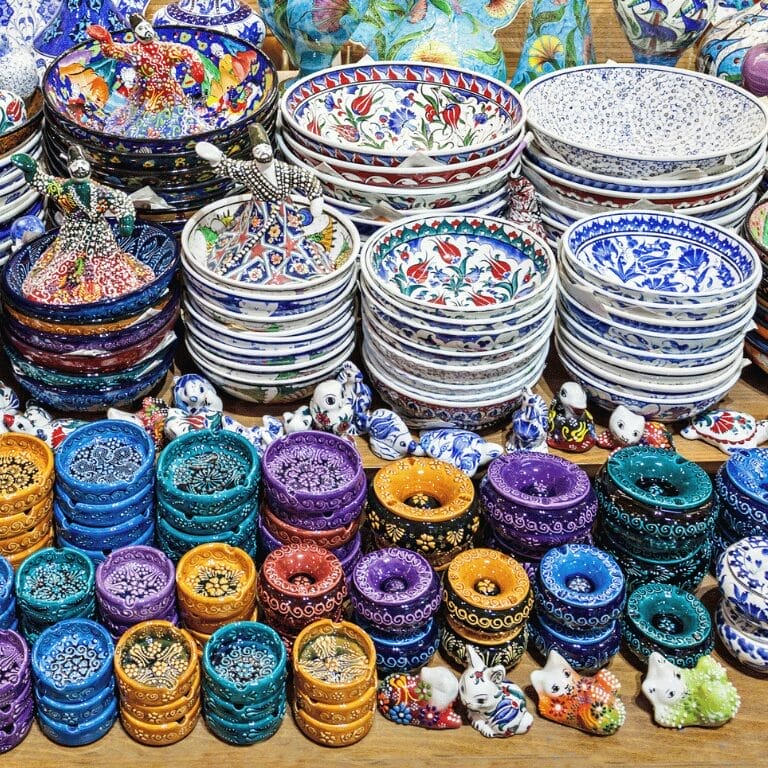
Copperware and Ceramics
Artisans still hand-beat copper trays, teapots and lamps into beautiful, functional objects. You’ll also find vibrant İznik tiles and painted pottery; these are perfect for adding a piece of Turkey to your home. Many shops let you witness the making process up close.
Textiles and Fashion
Silk scarves, embroidered pillowcases and Ottoman-style kaftans make the bazaar a great place for fashion lovers. Whether you’re looking for gifts or packing your suitcase, the blend of modern and traditional textile designs is always inspiring.
Sweets and Delights
Turkish delight, or lokum, comes in every flavour imaginable, including rosewater, pistachio, pomegranate and hazelnut. You’ll also find nut-filled baklava and sticky, honey-soaked treats. Sampling is encouraged, and most vendors provide generous tasters.

Tips for First-Time Bazaar Shoppers
Bargaining is normal, but always stay friendly. Smile, ask questions, and don’t rush.
Start with tea. Many shopkeepers will offer you a glass. It’s not just polite; it’s part of the tradition.
Carry cash. While some stalls accept cards, smaller vendors usually rely on cash.
Go early or late. Mornings provide a quieter experience, while evenings are lively with locals.
Watch your step. Bazaars can feel like a maze, with uneven cobblestones. Comfortable shoes are a must.
Where to Find the Best Turkish Bazaars
Grand Bazaar, Istanbul. One of the oldest and largest covered markets in the world, it has over 4,000 shops.
Spice Bazaar, Istanbul. This market offers a sensory experience with its rich mix of food, herbs and teas.
Kemeralti Bazaar, Izmir. A large market that combines Ottoman charm with modern city life.
Gaziantep Coppersmith Bazaar. It’s the perfect place for copper items, pistachios and traditional sweets.
Antalya Old Town Bazaar. This market is famous for textiles, souvenirs, and a laid-back seaside atmosphere.
The Heartbeat of Turkish Culture
Exploring a Turkish bazaar goes beyond making a purchase. It’s about experiencing the flow of local life. You’ll hear stories, share tea with strangers, and sense the heartbeat of Turkish culture in every interaction.
Whether you walk away with a hand-painted plate or just a memory of laughter over tea, the bazaar remains with you.
Explore Our Newest Travel Blogs & Tips
Temple of Hatshepsut: Where Power Meets the Cliffs of Luxor
Home Blog Temple of Hatshepsut: Where Power Meets the Cliffs...
Moulay Idriss: What to Know Before Visiting Morocco’s Holy City
Home Blog Moulay Idriss: What to Know Before Visiting Morocco’s...
Madaba: What Travellers Should Know About Jordan’s Mosaic City
Home Blog Madaba: What Travellers Should Know About Jordan’s Mosaic...